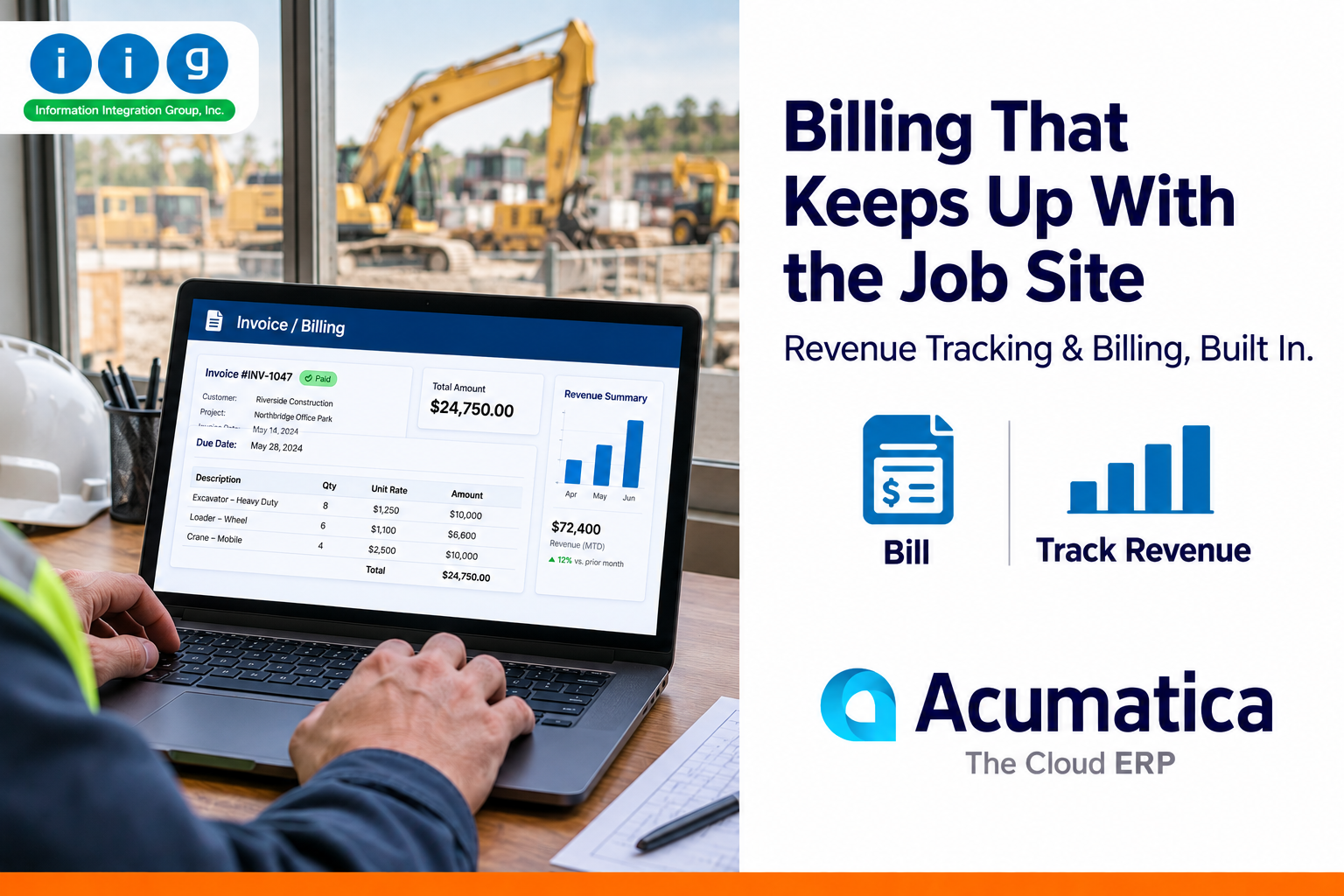
Billing errors on rental and project
equipment rarely come from dishonesty — they come from complexity. Equipment
moves between warehouses and job sites, gets billed to different customers or
projects, sometimes comes back missing a part or damaged, and somewhere in that
chain, revenue either gets tracked accurately or it doesn't. AcuFieldOps is built to handle that complexity directly,
rather than relying on someone reconciling it manually at month-end.
Revenue that follows how equipment
is actually used
Flexible revenue tracking allows
revenue to post to equipment ROI directly, to a project, or to generate
inter-company or customer invoices for rentals. That flexibility matters
because equipment rarely gets used the same way twice — one week it might be on
a straightforward customer rental, the next it's moved between two internal job
sites under different cost centers. The billing system needs to accommodate
both without requiring a different manual process for each scenario.
Cost posting that connects directly
to accounting
Cost for rentals can be posted
straight to the general ledger and project accounting, with invoices generated
based on cost-plus-markup using project accounting. This is the piece that
closes the loop between field operations and finance — instead of a separate
spreadsheet tracking markup calculations, the invoice generation itself is
built on the actual project accounting data already in the system.
Handling the billing situations that
usually cause disputes
Two of the more common billing
headaches in equipment rental are rate changes and missing or damaged items —
and both are addressed directly. Item or serial numbers can be swapped on
rental contracts, and rental rates can be changed on existing rentals when
price increases apply, all with visibility into when each line was entered,
shipped, invoiced, and returned. That visibility matters when a customer
questions a charge — the full transaction history is there, not reconstructed
from memory.
For missing or damaged items, an
invoice can be generated to bill for those specifically, with a grace period
built in before billing customers for missing or damaged products. That grace
period is a small detail with a real business impact — it protects the customer
relationship by allowing time for an item to turn up before a charge goes out,
while still ensuring the business isn't absorbing the cost of genuinely lost or
damaged equipment.
Projects and production work orders,
generated from the same entry
Revenue tracking isn't limited to
simple rental billing. Projects and production work orders can be created
directly from rental contract entry, based on project templates and defined
production options and routing steps. That means a single contract entry can
trigger both the billing side and the operational side of a job — install,
assemble, or teardown work — without needing to be entered twice into two
different parts of the system.
Why this matters for cash flow, not
just accuracy
Billing delays and disputes don't
just create accounting headaches — they slow down cash flow. When revenue
tracking is tied directly to the same system managing equipment movement,
service history, and project work, invoices go out faster and with fewer
disputes, because the data backing them up was captured at the moment the work
actually happened, not reconstructed afterward.
Frequently Asked Questions
Can rental rates be changed on a
contract that's already active?
Yes — rental rates can be changed on existing rentals when price increases
apply, without needing to cancel and recreate the contract.
How does billing handle equipment
that's damaged or goes missing?
An invoice can be generated specifically for missing or damaged items, with a
grace period built in before the customer is billed — giving time for the item
to be located before a charge is finalized.
Does the system support
cost-plus-markup billing?
Yes — invoices can be generated based on cost-plus-markup using project
accounting, so the markup calculation is tied directly to actual project costs
rather than a separate manual calculation.
Can one rental contract generate
both a bill and a work order?
Yes — projects and production work orders can be created directly from rental
contract entry, based on project templates and routing steps, so both the
billing and operational sides of a job are triggered from one entry point.
Want to see how revenue tracking and
billing could reduce disputes and speed up cash flow for your fleet? Reach out.
📧 sales@iigservices.com | 📞 (818) 956-3744