The Hidden Cost of Standalone Rental Software
Most equipment rental software on the market today is built as a standalone platform — a dedicated tool for managing rental orders, availability, and customers that sits apart from a business's core accounting and financial system. For small rental operations, this can work fine in the early stages. But as a rental business grows, standalone rental software starts to show its limits.
The core issue is disconnection. Standalone rental software typically requires integration with a separate accounting or ERP system to handle invoicing, financial reporting, and project costing. That integration is rarely seamless — data often has to be manually exported, synced, or reconciled between systems, creating delays and opening the door to errors.
What an ERP-Native Rental Software Solution Looks Like
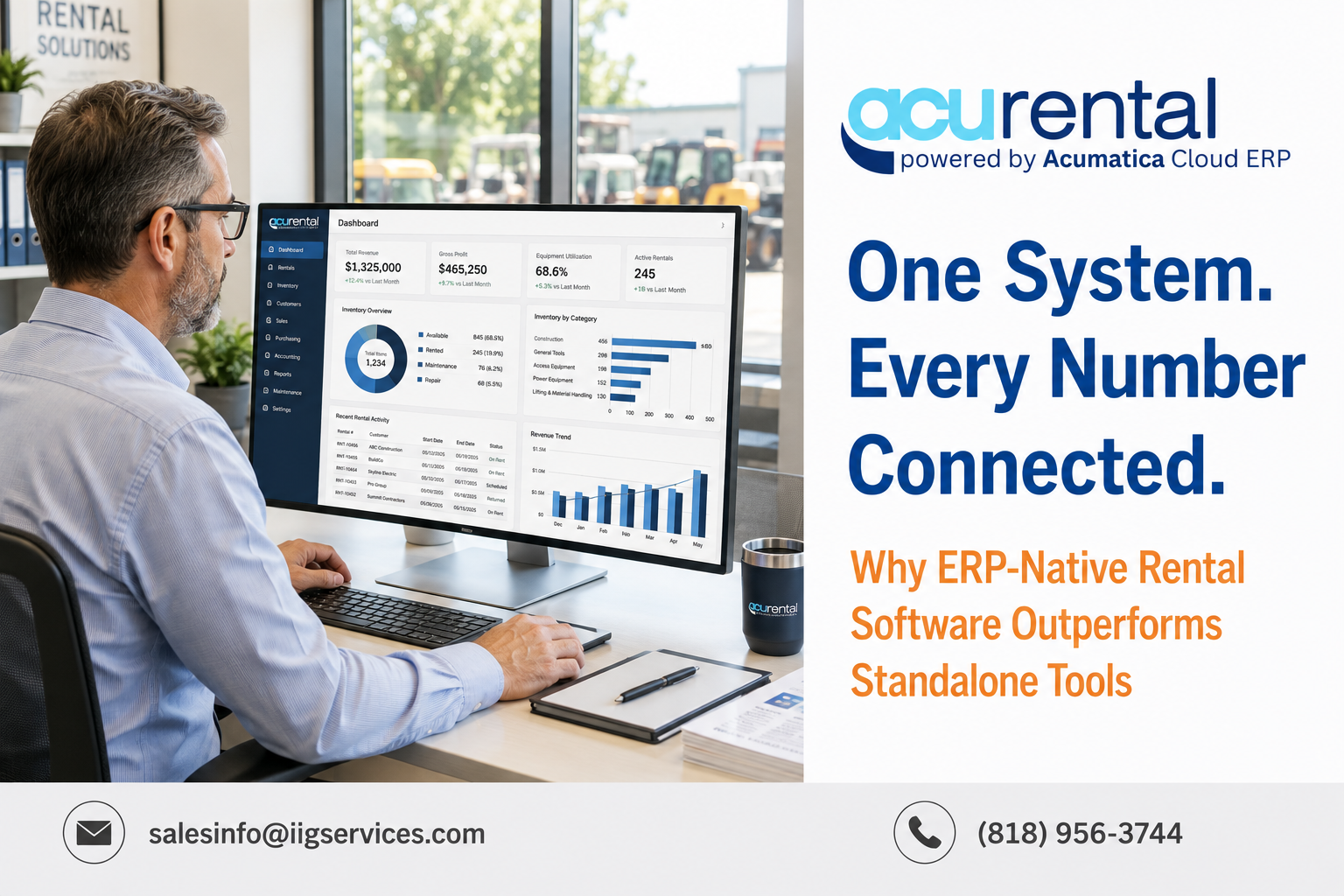
AcuRental takes a fundamentally different approach. Instead of functioning as a bolt-on rental tool, AcuRental is built natively within Acumatica Cloud ERP. Rental order processing, inventory, CRM, purchasing, and financials all run on the same underlying platform and database.
This means when a rental order is created, updated, or invoiced in AcuRental, that information is immediately part of the same system driving financial reporting — no export, no sync delay, no reconciliation step. For growing rental businesses, this translates into faster month-end closes, more accurate reporting, and fewer discrepancies between what operations sees and what finance sees.
Where the Difference Shows Up Most
The gap between standalone rental software and an ERP-native solution like AcuRental becomes most visible in three areas: billing accuracy, project-level visibility, and scalability. Flexible billing periods, automated credit memos for
early or late returns, and accurate project P&L reporting all depend on rental and financial data living in the same system rather than being stitched together after the fact.
Scalability is another factor. As a rental business adds locations, expands its fleet, or takes on more complex billing arrangements, a standalone system's integration points often become the first thing to break down. An ERP-native platform is built to scale as one system, not as a growing set of connected tools.
Is an ERP-Native Solution Right for Every Rental Business?
Not necessarily — a very small rental operation with simple, low-volume transactions may not yet need the depth of an ERP-native platform. But for rental businesses experiencing growth, adding verticals, or struggling with reporting accuracy between rental and accounting systems, the case for equipment rental software built natively on an ERP becomes much stronger.
The right decision comes down to evaluating current pain points honestly: How much time does your team spend reconciling rental data with financial reports? How often do billing errors occur on early or late returns? Those answers often point clearly toward whether a standalone tool or an ERP-native platform like AcuRental is the better long-term fit.
What to Ask Before You Switch
Before moving away from a standalone rental system, it helps to ask a few direct questions: Does the new platform require a separate integration to connect with accounting, or is that connection native? How are early and late returns handled — automatically, or through manual adjustment? Can the system support multiple locations, verticals, or business units without added complexity? The answers to these questions typically reveal how much of the day-to-day reconciliation work a rental team is currently doing simply to keep two systems in sync.
It's also worth considering the long-term cost of staying on a standalone system. Integration fees, ongoing sync issues, and the staff time spent manually correcting mismatched data all add up over time — costs that are easy to overlook when comparing software on price alone, but that become significant as a rental business scales.
The Bottom Line for Growing Rental Businesses
For rental businesses that have outgrown basic tools or are tired of maintaining two disconnected systems, an ERP-native platform like AcuRental offers a more sustainable foundation for growth. Rather than adding integrations to patch gaps between rental and financial software, an ERP-native approach removes the gap entirely — giving rental teams one accurate source of truth from the first quote to the final invoice.
Frequently Asked Questions
1.What does it mean for rental software to be 'ERP-native'?
It means the rental functionality is built directly inside an ERP platform — sharing the same database and system as financials, inventory, and CRM — rather than existing as a separate tool connected through integrations.
2.Is AcuRental only for large rental businesses?
No. AcuRental is built to scale, making it a fit for growing rental businesses of various sizes, particularly those experiencing the reporting and reconciliation challenges that come with expanding operations.
3.What ERP platform is AcuRental built on?
AcuRental is built natively on Acumatica Cloud ERP, combining rental order processing with full financial, inventory, and CRM functionality in one system.
Call to Action
Ready to see how an ERP-native rental solution compares to your current system? Contact Information Integration Group, Inc. at salesinfo@iigservices.com or (818) 956-3744 to schedule a walkthrough of AcuRental.