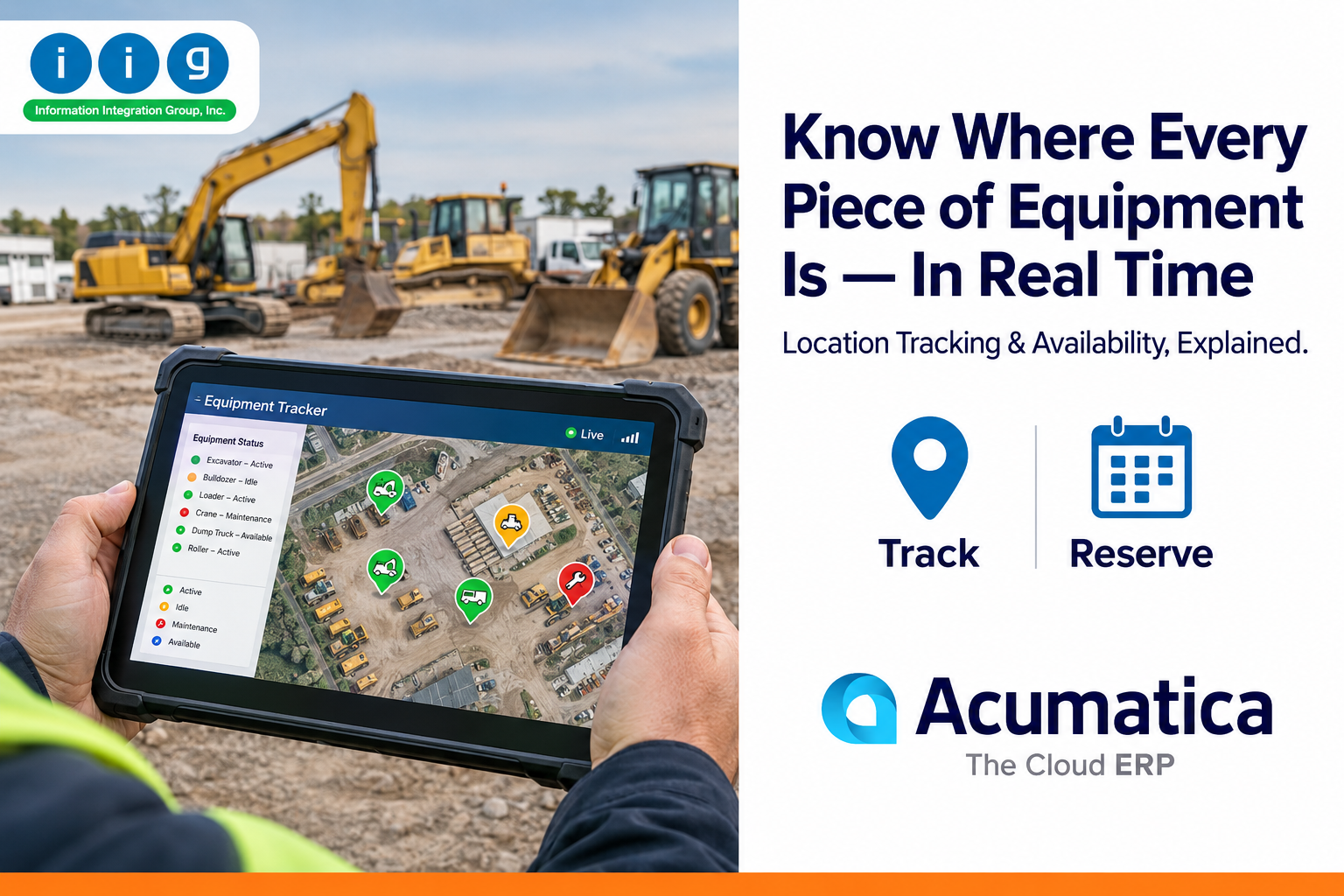
Most construction and rental companies don't lose equipment because nobody's paying attention — they lose it because the way they're tracking it doesn't scale. A logbook works fine with five pieces of equipment across one yard. It falls apart at fifty pieces across three job sites, especially when equipment moves between warehouses and job sites on a near-daily basis.
Construction Equipment Management software solves this by pairing telematics or RFID tracking with a live view of equipment location, tied directly to the same system that handles billing, service history, and scheduling — not a separate app that nobody remembers to check.
How location tracking actually works
Equipment location tracking uses telematics or RFID to identify exactly where a piece of equipment is at any given moment. That's the baseline. What makes it useful operationally is what's built around it: automatic alerts for trouble or upcoming services, so a location update isn't just a dot on a map — it's paired with a signal that something needs attention.
This matters because most equipment problems aren't sudden. A piece of equipment overdue for service, sitting idle longer than expected, or missing from where it should be are all things a location-and-status system can flag before they become a bigger issue — a breakdown mid-job, a missed billing window, or equipment nobody can locate when a customer asks for it back.
Time-based availability changes how equipment gets assigned.
Once you know where equipment is, the next question is whether it's actually available. Time-based availability lets teams view equipment availability in real time, make reservations, and create orders to move equipment to job sites — instead of a phone call to the yard asking "is the mini excavator free next Tuesday?"
For companies running multiple job sites at once, this is often the single biggest source of wasted coordination time. A dispatcher checking a shared spreadsheet, calling three site supervisors, and still getting it wrong isn't unusual — it's the default when there's no connected system tracking reservations against real equipment status.
Move tickets, without the paperwork
Getting equipment out to a job site (and getting it back) generates its own layer of admin work — who moved it, when, in what condition. Construction Equipment Management software handles this by generating move tickets through barcode or RFID scanning, whether that scan happens in the yard or right at the job site. Setup, teardown, drive-back, and check-in/check-out timing all get tracked as part of that same scan, rather than reconstructed later from memory or a driver's notes.
Why this connects back to the bigger picture
Location tracking and availability aren't standalone features — they're the foundation everything else in equipment management sits on top of. You can't calculate accurate equipment ROI, plan maintenance around real usage, or bill a rental correctly if you don't have a reliable, real-time picture of where equipment is and whether it's actually available. Get this piece right, and the rest of fleet management gets measurably easier.
Who this is for
This is most relevant for construction companies and equipment rental operations managing a fleet across multiple job sites or warehouses — the kind of business where "where's the excavator" is a question that comes up more than once a week.
Frequently Asked Questions
What's the difference between telematics and RFID tracking for construction equipment?
Telematics uses GPS and onboard sensors to track equipment location and usage remotely, typically suited for larger, higher-value machinery. RFID uses tags scanned at fixed points (like a yard gate or job site entrance) to confirm equipment movement at specific checkpoints. Many Construction Equipment Management systems support both, depending on the equipment type and how precise the tracking needs to be.
Can time-based availability prevent double-booking equipment?
Yes — since reservations and current status (available, reserved, on rent, out for service) live in the same system, a piece of equipment already reserved for one job site won't be assigned to another at the same time, which is the most common source of scheduling conflicts in manual tracking setups.
Do move tickets require special hardware?
Not necessarily — many systems support barcode or RFID scanning from a standard mobile device or tablet, so equipment moves can be logged directly at the yard or job site without dedicated scanning hardware.
How does this connect to billing?
Because equipment location and availability data feeds into the same platform as rental and project billing, moves and usage periods can be tied directly to invoices — reducing the gap between when equipment is used and when it's billed.
Have questions about equipment location tracking or availability for your fleet? Reach out to our team — we're happy to walk through how this works for your specific setup. sales@iigservices.com | (818) 956-3744