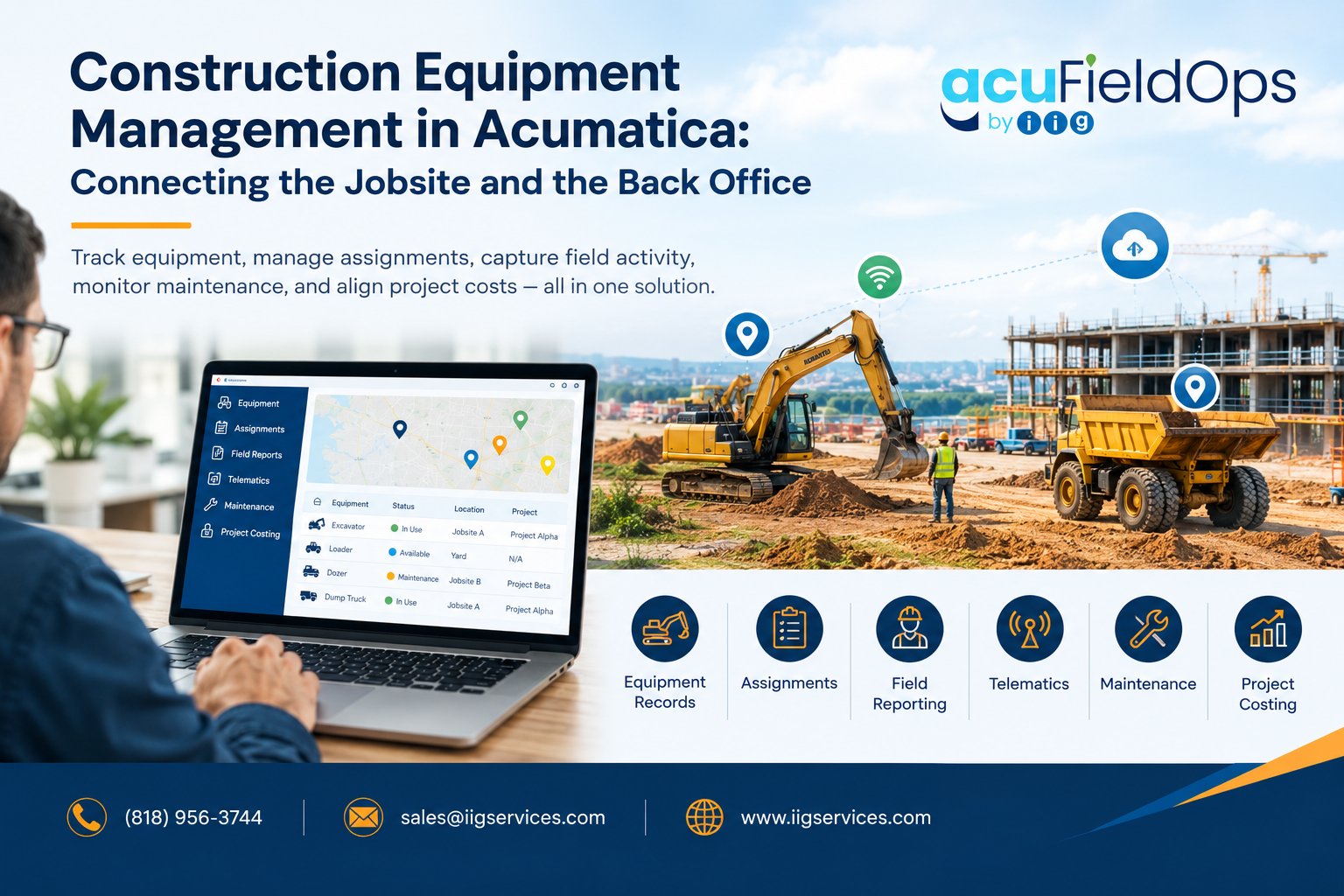
Construction businesses depend on
equipment to keep projects moving. From excavators and loaders to service
vehicles and specialized machinery, every asset needs to be available at the
right place and time. But managing equipment across multiple jobsites, yards,
and projects gets complicated when field activities and back-office records are
disconnected.
Equipment location is only one part
of the challenge. Businesses also need to understand equipment assignments,
availability, maintenance requirements, field activity, and the costs of using
each asset.
That's where AcuFieldOps
comes in. If you've worked with IIG's Construction Equipment Management
solution, this is the same product under a new name. AcuFieldOps connects
equipment and field operations with Acumatica, giving businesses a more
connected view of construction activities and business performance.
Same Solution, New Name
AcuFieldOps was formerly known as Construction Equipment Management. The new
name reflects the product's broader focus on field operations. Existing users,
partners, and anyone who has researched Construction Equipment Management are
looking at the same solution.
Why Connecting the Jobsite and Back
Office Matters
Field teams work in changing conditions. Equipment moves between jobsites,
assignments change as project requirements evolve, and maintenance needs can
affect availability. Meanwhile, office teams need reliable information to
coordinate resources, manage costs, and understand project performance.
When these activities are managed
through disconnected tools or manual updates, important details are hard to
access. Teams may spend time confirming equipment locations, checking
availability, or reconciling field information with back-office records.
Connecting equipment operations with
Acumatica brings operational information closer to the financial and project
data businesses already use to run the business.
1. Maintain Better Equipment Records
Equipment management starts with useful information about each asset.
Businesses need to identify equipment, review relevant records, and understand
its operational status.
Centralized equipment information
helps teams make more informed decisions about how assets are used and
maintained. Instead of separate records in each department, equipment
information becomes easier to access as part of the broader Acumatica
environment.
For construction businesses managing
large equipment inventories, this visibility supports more consistent
coordination between operations and administration.
2. Connect Equipment Assignments to
Project Needs
Knowing where a machine is located is valuable, but knowing where it's needed
next is just as important.
Equipment assignments help
businesses match assets to jobsites and project requirements. When teams have a
clearer view of assignments and availability, they can spot potential
conflicts, coordinate equipment movements, and make better use of existing
resources.
For Acumatica partners, this is an
important discovery area. Ask clients how they currently assign equipment,
record transfers between jobsites, and decide whether equipment is available
for an upcoming project. These conversations can reveal ways to improve
coordination without adding more disconnected processes.
3. Improve Field Reporting and
Telematics Visibility
Construction operations generate information throughout the workday. Field
reporting captures jobsite activity, while telematics and location-related
capabilities provide insight into equipment movement and use.
Bringing these operational details
into a connected workflow helps office teams understand what's happening in the
field and respond with better context. For example, when project managers and
operations teams can review equipment information alongside project records,
they can coordinate resources and investigate operational issues more
effectively.
The objective isn't simply to collect
more data. It's to make relevant field information useful to the people
responsible for planning, execution, and oversight.
4. Connect Maintenance With
Equipment Availability
Maintenance is another essential part of equipment management. Repairs and preventive
maintenance affect whether equipment can be assigned to a job, and maintenance
history helps teams understand an asset's service needs.
Connecting work orders and
maintenance processes with equipment records helps businesses coordinate
service activities with equipment planning. It also gives teams a clear
starting point for understanding why an asset is unavailable and what action is
needed.
For businesses managing equipment
across multiple locations, this connection supports better decisions about scheduling,
service, and resource allocation.
5. Improve Project Costing and
Financial Visibility
Equipment decisions have financial implications. Ownership costs, maintenance
expenses, utilization, and project assignments all influence how businesses
evaluate their resources.
When equipment operations are
connected with Acumatica's financial and project information, businesses can
work toward a more complete view of equipment-related costs and performance.
This visibility helps management ask more useful questions:
- Are equipment resources being assigned effectively?
- Which costs should be reviewed against a project?
- Are maintenance requirements affecting planned work?
- Where could equipment planning improve?
The answers depend on the
information captured and how the business configures its workflows, but
connecting operational and financial data provides a stronger foundation for
analysis.
How Acumatica Partners Can Identify
Opportunities
For VARs and implementation partners, equipment management is an opportunity to
look beyond basic asset tracking and understand how clients coordinate their
field operations. Consider asking:
- How do you track equipment locations and project
assignments?
- How do field teams report equipment activity?
- How do you monitor maintenance and equipment
availability?
- How do equipment-related costs connect with project
financials?
- Which processes still depend on spreadsheets or manual
updates?
The answers can show where
AcuFieldOps, formerly Construction Equipment Management, can support a more
connected equipment management process.
Bring Equipment Operations and
Business Information Together
Construction equipment management works best when the jobsite and the back
office aren't operating in isolation. Equipment records, assignments, field
reporting, telematics, maintenance, and project costing all contribute to a
clearer understanding of how resources are being used.
With AcuFieldOps (formerly
Construction Equipment Management), Acumatica partners can connect equipment
operations with the broader ERP environment and help construction businesses
make better-informed operational decisions.
Ready to explore equipment
management in Acumatica? Let's talk.
📞 (818) 956-3744 | ✉️ sales@iigservices.com | 🌐 www.iigservices.com
Learn more: https://www.iigservices.com/equipment-management
#Acumatica #CloudERP #AcuFieldOps
#ConstructionEquipmentManagement #ConstructionTech #EquipmentManagement
#FieldOperations #IIG